

Social history, unlike political history, examines various aspects of life and culture from a bottom-up perspective—how governmental regulations affect people’s lives and behaviors. It delves into the processes and outcomes of human actions to provide a more complete picture of a period, beyond the achievements of political or intellectual history.
Orhan Pamuk, a Turkish writer, portrays a part of Istanbul’s history by writing the historical novel “The Museum of Innocence,” set in Istanbul, and by collecting objects related to fictional characters and events in the novel, establishing a personal museum in a building in Istanbul. He sees the philosophy behind setting up a museum as overcoming the linear course of time. In his novel, in accordance with Aristotle’s theory, he views time as having two aspects: the timeline (which ends in death) and the present time. According to Pamuk, this timeline connects all objects and moments, but contemplating this temporal course is very painful because it leads towards death. Yet sometimes these moments we call “now” can bring such joy and pleasure that it lasts for a century. The author considers collecting objects related to his lover as preserving these present moments. He believes objects have a soul that preserves and conveys the historical essence of the moment forever. For me, my hometown of Zanjan was akin to Pamuk’s character “Fusun,” his lover, which inspired me to try and document the existing artifacts by collecting objects related to each story and arranging them as a visual record.
This personal interest stemmed from the absence of written sources about cultures, rituals, and stories, and the fear of losing the customs and traditions of a period when my grandparents and parents lived. This led to the collection of stories, events, and the lives of the people of Zanjan from the 1920s to the 1950s, aiming to document a part of Zanjan’s social history.
Human sensory perceptions are one of the most important components in social history studies. The necessity of documenting Zanjan’s social history compelled me to attempt documenting the existing artifacts by collecting objects related to each story and arranging them visually. The result was an exhibition combining photography, literature, and arrangement, allowing viewers to touch, smell, taste the objects in the photos, and listen to the stories they represent.
Goygoz
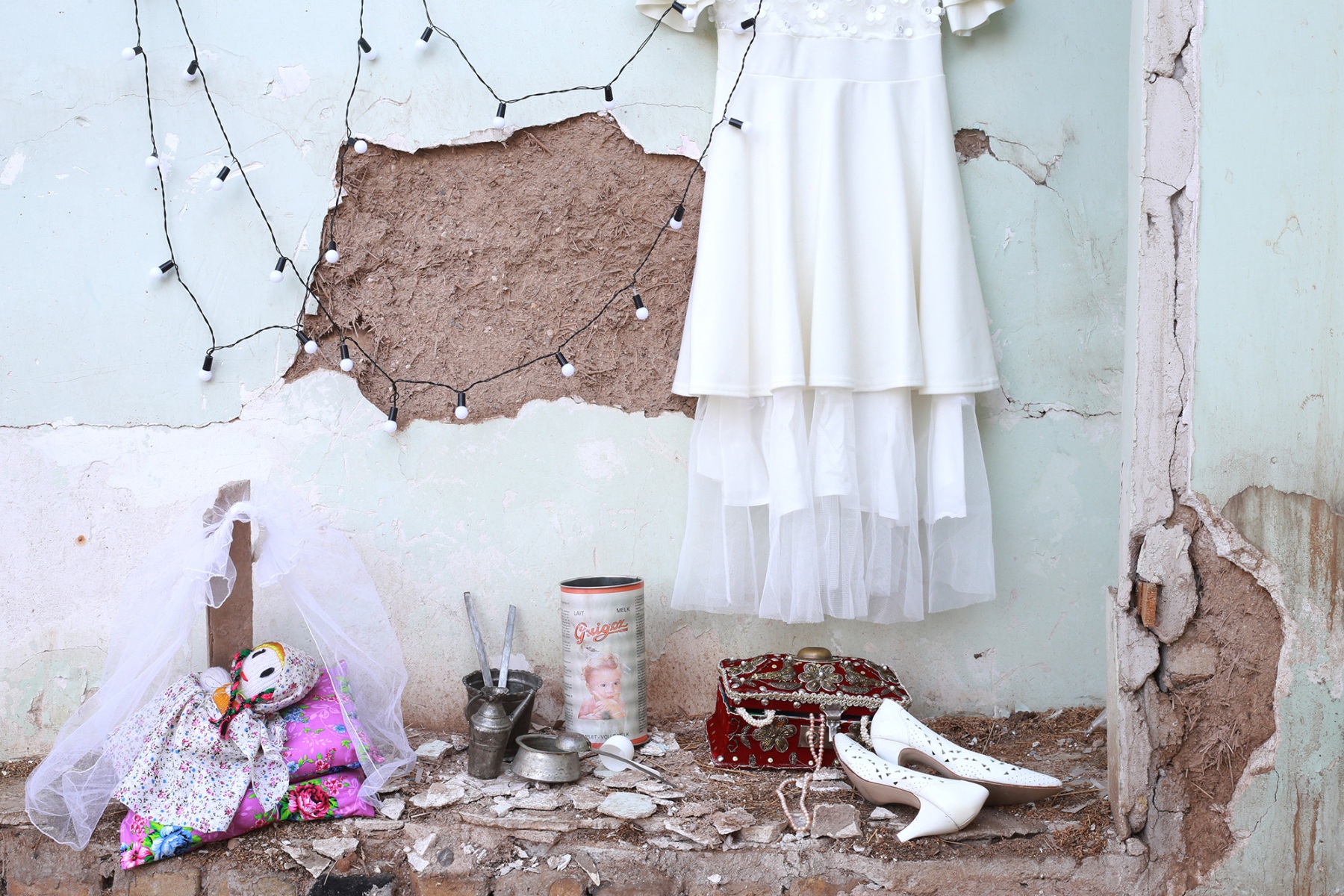
It was a memorial service for a relative. Mohammad Ali Khan entered the room and immediately took a seat on the single Erj steel chair. He had this habit of carefully choosing his seat at every gathering to avoid creasing his suit. As he dabbed his face with a silk handkerchief, he turned to the little girls playing nearby and said, “Well done, girls! Whoever brings me a glass of water first, I’ll marry her.” Zahra dashed off, bringing him a cold glass of water, and, to everyone's surprise, Mohammad Ali Khan honored his playful promise by formally proposing to Zahra the following week. She was only twelve. Zahra’s only idea of marriage came from watching her cousin, a newlywed, who wore beautiful clothes, high heels, and went on outings with her husband. Zahra believed marriage meant pretty clothes and trips together. She had, of course, noticed Mohammad Ali Khan around. He wore a different suit in the morning and another set in the afternoon. His slicked, paraffin-treated hair shone as he walked through the alleys, with his leather shoes creaking and his cologne lingering in the air long after he passed. Mohammad Ali Khan wasn’t that much older—only twenty or twenty-one himself—but he’d inherited vast lands and properties from his late father. Despite the disapproval of relatives, he stood by his words, and Zahra became his bride. Because she was so young and small, they bought her a pair of white, ten-centimeter heels, stuffing the toes with cotton. It was around 1954, and only a handful of cars could be seen on the streets of Saadi and Pahlavi in Zanjan. One of those cars belonged to the local police force, where Zahra’s uncle served as the chief. They decorated the police car with ribbons to carry Zahra to her new home. Akbar Agha, the family's inventive young man, fashioned a string of colorful lights, wrapping it around the bride and connecting the ends to a battery. Zahra herself held the exposed wire ends, periodically touching them to the battery to create a blinking effect. The whole family contributed to what they proudly called a memorable wedding celebration. The large house on Shalchi Alley, which Mohammad Ali Khan owned, became the new bride’s domain the day after the wedding. A housekeeper pampered Zahra, handling all chores while she idly enjoyed her new role, often playing with her cloth dolls and roughhousing with Mohammad Ali Khan’s younger siblings, who were about her age. It wasn’t long before the young bride’s role transformed into that of a pregnant woman, waiting for Mohammad Ali Khan’s child. Though now expecting, she still played and frolicked like a child herself. One day, while playing hide and seek, Zahra crawled into the kitchen oven. Mohammad Ali Khan’s brother, seeing an opportunity to prank her, sat on the oven door, trapping her inside until the oven mites bit her all over. When their daughter Farideh was born, it was winter. Zahra was still so young that she struggled to breastfeed her baby. Mohammad Ali Khan managed to procure a carton of Gigoz formula from Tehran—the family called it "Blue-Eyed Milk"—to keep the child fed. One morning, Zahra decided to take her forty-day-old baby to Mirli Bathhouse. The housekeeper pleaded with her not to take the baby out in the bitter cold, but Zahra wouldn’t listen. She rented a cart from Mussa the Cartman at the alley and placed the swaddled Farideh inside, not realizing that a newborn could not withstand the minus-thirty-degree temperatures of the 1955 winter. The cold still lingered. Zahra had laid her cloth doll in Farideh’s empty swaddle. Mohammad Ali Khan’s siblings and Zahra played “Guest and Host,” with Zahra acting as the host and serving Farideh’s formula in tiny copper cups to her pretend guests.